
Which Swim Spa Sizes Offer Enough Room for Your Swim Stroke?
Which Swim Spa Sizes Offer Enough Room for Your Swim Stroke? — Wellness
A longer swim spa does not always give you more room to swim. Learn how interior width, seating layouts and current quality affect stroke clearance, then use a practical fit checklist to narrow your options.
Comparing swim spa sizes starts with a question that exterior dimensions alone cannot answer: can you complete your normal stroke without touching the walls, seats or floor? A longer shell may provide more room, but seating, steps and separate soaking areas can reduce the space available for swimming.
For a useful shortlist, compare three things: the unobstructed swim area, clearance for your preferred stroke and the current’s ability to hold you in a comfortable position. Your height matters, but so do your arm span, kick width and swimming technique.
This guide explains how to evaluate those details before buying, including what to measure, what to ask the retailer and why a wet test is more useful than choosing by advertised length alone.
How swim spa sizes translate into actual swimming room
Exterior length is a starting point, not a swimming clearance measurement. A model advertised as 16 feet long does not necessarily provide 16 feet of open water. The cabinet, shell shape, entry steps and seating all affect the interior layout.
The dimensions that matter most are:
- Usable swim length: The unobstructed distance available in the intended swimming position.
- Usable swim width: The clear width where your hands, elbows and feet travel, including below the waterline.
- Operating water depth: The water depth at the recommended fill level, rather than the exterior cabinet height.
- Current position: Where you need to swim relative to the outlets or propulsion system.
When comparing swim spa sizes, ask for an interior drawing that identifies the swim lane, seating intrusions and recommended swimming position. A specification sheet listing only exterior length, width and height cannot establish whether your stroke will fit.
Also distinguish stationary swimming from lap swimming. A swim spa lets you swim against a current rather than travel repeatedly between opposite walls. Additional length can improve clearance and flexibility, but it does not turn the spa into a conventional lap pool.
Compare advertised length ranges without treating them as guarantees
The following nominal-length bands are useful for organizing a shopping list. They are not universal minimums for particular strokes. Two models in the same band can have substantially different usable interiors.
| Advertised length band | What to investigate | Main sizing concern |
|---|---|---|
| Approximately 12-14 feet | Whether the swimming position leaves enough room for full reach and kicking | Steps or seats may compete with the swim area |
| Approximately 15-17 feet | Whether added length creates more unobstructed swimming space | A longer shell may still have a narrow stroke envelope |
| Approximately 18-21 feet or longer | How length is divided between swimming and other uses | Separate zones or additional seating may account for part of the footprint |
For an initial comparison, Hearthside Supply’s compact swim spa listings and larger swim spa listings provide different starting points. Check each model’s specifications rather than assuming its seating capacity tells you how much swimming room it offers.
The best swim spa sizes for your shortlist are those that provide enough clear space in the actual swim zone, not simply the largest exterior dimensions you can accommodate.
A person-capacity label is especially easy to misread. It describes a different consideration from stroke clearance and should not be treated as a swimming-performance rating.
Match the interior to your preferred stroke
Freestyle: check reach, kick clearance and sideways drift
Freestyle generally uses a narrower movement pattern than breaststroke or butterfly, but it still requires room for a complete arm recovery and kick.
Check whether your forward reach brings your hands too close to the current outlets. Behind you, your feet should have clearance from seats, steps and the rear wall. At your sides, allow room for normal body rotation and small changes in position.
A narrow lane may feel acceptable when you are perfectly centered yet restrictive when you drift slightly. The goal is to swim naturally, not to shorten your reach or keep your elbows unusually close to avoid contact.
Breaststroke: prioritize underwater width
Breaststroke makes interior width particularly important because both the arm sweep and kick extend outward. A shell that looks spacious at the waterline may taper or contain seating ledges below it.
When evaluating swim spa sizes for breaststroke, compare the width at the depth where your hands and feet actually move. Surface width alone can overlook the part of the shell most likely to interfere with your kick.
Ask whether the manufacturer identifies a clear breaststroke area. If no interior measurements are available, a wet test becomes especially valuable. Do not assume that extra length compensates for a narrow underwater profile.
Butterfly and backstroke: test the complete movement
Butterfly requires clearance for a broad arm recovery, along with enough depth for your usual kick and body movement. A spa suitable for your freestyle may not accommodate butterfly comfortably.
Backstroke raises a different concern: maintaining position without looking toward the current source. You need room for overhead arm movement and some allowance for lateral drift, plus a current that works for your technique.
If either stroke is central to your training, make it a condition of the demonstration. Watching someone else swim freestyle does not establish that your preferred stroke will fit.
Measure your stroke envelope before measuring the backyard
Start with your movements, not your height alone
Your height provides useful context, but it does not capture your full movement pattern. Two equally tall swimmers can have different arm spans, kick widths and swimming positions.
As a preliminary check, have another person help measure your arm span and observe the broadest parts of your usual stroke. You can also use a familiar pool to identify how much space you occupy during normal swimming.
For a meaningful comparison of swim spa sizes, record your approximate movement envelope alongside each model’s unobstructed interior dimensions. Treat those measurements as screening tools, not proof of fit.
Dry measurements cannot reproduce buoyancy, body rotation or how you respond to a current. They can eliminate an obviously restrictive layout, but they should not replace an in-water trial when stroke fit is a purchase priority.
Ask for measurements at the right locations
Request the clear width at both hand and foot depth, the distance from the intended swimming position to rear obstructions and the operating water depth in the swim zone.
Also ask where the measurements were taken. A maximum interior width measured beside a seating area may not describe the width available to a swimmer.
Photographs can help you identify steps and benches, but perspective makes them unreliable for judging clearance. An annotated drawing or measurements taken at the swim position are more useful.
For a household with several swimmers, evaluate the tallest or widest-moving person and anyone whose preferred stroke needs extra room. The shortest swimmer’s successful test does not establish fit for everyone.
Use a wet test to confirm comfortable clearance
A wet test is the most direct way to assess whether you can swim naturally in a particular layout. If one is available, arrange to try the exact model or establish how the demonstration model differs.
Before testing, ask the retailer to explain the controls, safe swimming position and any manufacturer restrictions. Then swim your normal strokes at a comfortable pace before trying more demanding settings.
When testing swim spa sizes, notice whether you change your technique to avoid the shell. Shortening your reach, narrowing your kick or repeatedly stopping to recenter can indicate a fit or current problem.
Use this simple test checklist:
- Complete full arm strokes without touching walls or seating.
- Kick normally without contacting the floor, steps or rear obstructions.
- Check clearance when slightly off-center, not only in the ideal position.
- Try the current settings you expect to use most often.
- Repeat the test for each household member who plans to swim.
If a wet test is unavailable, request detailed interior measurements and written answers about intended stroke use. Review the applicable purchase and return terms before ordering rather than assuming an installed spa can be returned after a fit trial.
Separate current quality from physical room
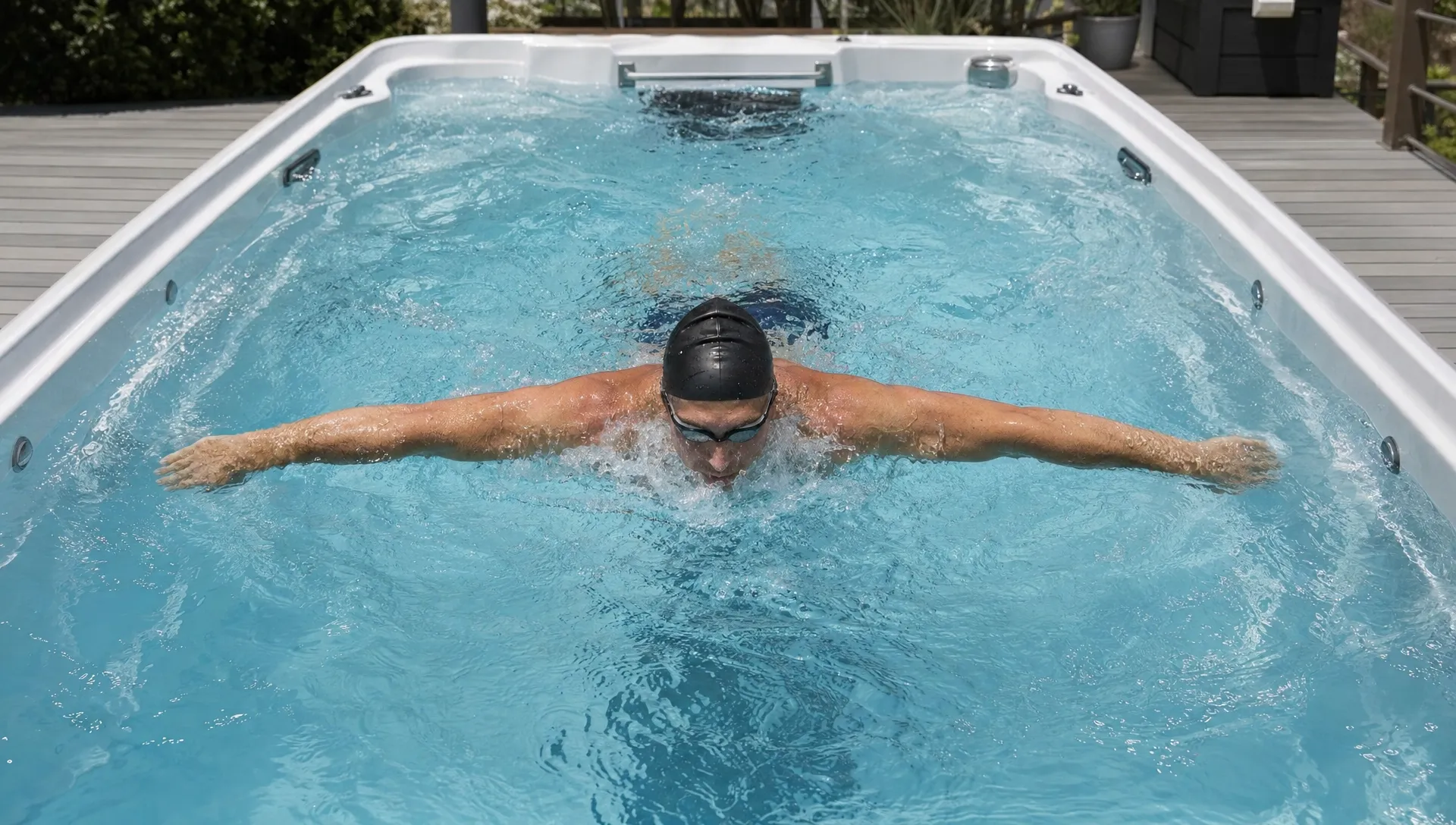
Enough space and a suitable current are separate requirements. A spacious interior cannot compensate for a current that does not match your pace, and a strong current cannot create clearance where a bench obstructs your kick.
Current width, adjustability and flow consistency affect how easily you remain in position. If the flow pushes you sideways or requires frequent corrections, you may feel cramped even when the interior measurements initially look adequate.
Comparing swim spa sizes without considering the current can therefore produce a misleading shortlist. Evaluate both together, using your normal technique rather than a brief demonstration at an unfamiliar pace.
Hearthside Supply’s guide to propulsion and jet swim current systems explains the system differences to investigate alongside dimensions.
Do not use total jet count as a substitute for this assessment. Ask specifically about the swim-current system, its adjustment range and whether you can test it at the speeds you expect to use.
Check the installation footprint beyond the shell
Leave space for access, covers and delivery
Once you identify a suitable interior, verify that the complete installation fits your property. The shell footprint is only part of the required space.
Allow for the manufacturer’s service clearances, entry steps, safe walking access and the selected cover-opening arrangement. These requirements vary by model and installation, so use the installation manual rather than a generic clearance allowance.
The right swim spa sizes for your property must satisfy both swimming needs and site constraints. Confirm the foundation requirements, filled weight and electrical specifications with the manufacturer and appropriate licensed professionals.
Delivery access also needs a separate check. Measure gates, turns and overhead obstructions, then discuss the route with the delivery provider. A spa that fits its final location may still require specialized placement equipment to reach it.
Verify local permit, electrical and pool or spa barrier requirements before committing to the layout. If you are considering a deck installation, have its capacity evaluated for the specific unit and loaded conditions.
Plan other wellness products without crowding the swim area
If your backyard plan includes a sauna, place both products on the same scaled site drawing before choosing the swim spa. Include separate entry routes, service access and any manufacturer-required clearances.
For example, homeowners considering the Golden Designs Karlstad 6-Person Hybrid Outdoor Sauna or the Cayman 4-Person Outdoor Traditional Wet/Dry Sauna with 6kW Harvia Heater should check each product’s actual specifications alongside the spa’s installation requirements.
That comparison helps you assess the whole backyard layout without assuming either sauna’s footprint. Avoid sacrificing safe access around the swim spa simply to fit another product into the same corner.
Narrow your shortlist using evidence, not length alone
A useful comparison worksheet should include exterior dimensions, usable swim length, underwater width, operating depth, seating intrusions and current-system details. Add installation clearances and delivery requirements in separate columns so you do not confuse swimming fit with site fit.
Rank swim spa sizes by how well the specific models satisfy your stroke requirements, then eliminate options that do not fit the property or installation plan.
If two models appear suitable, prioritize the one you can evaluate more confidently through a wet test, clear drawings and complete documentation. More shell length is worthwhile only when it gives you space you will actually use.
Be cautious if a seller can provide seating capacity and exterior length but cannot explain the swimming area. Missing measurements are a reason to ask further questions before purchasing, especially for breaststroke, butterfly or taller swimmers.
Frequently asked questions
Is a 13-foot swim spa big enough for swimming? It may be, depending on your body size, stroke, the interior layout and the current. The advertised length alone cannot establish fit. Check the clear swim area and test the model if possible.
Does a 20-foot swim spa always provide more swimming room than a 16-foot model? No. Additional length may accommodate seating, a separate zone or other layout features. Compare the unobstructed swim area rather than assuming all extra length becomes usable swimming space.
Which swim spa sizes work best for tall swimmers? Choose based on full reach, kick clearance and the intended swimming position. Taller swimmers may benefit from more usable length, but there is no reliable exterior-length rule that applies across all designs.
Can you swim breaststroke or butterfly in any swim spa? Do not assume so. Breaststroke needs sufficient underwater width, while butterfly requires broad arm clearance and suitable depth. Confirm the manufacturer’s intended use and test your complete stroke where possible.
How much space should remain around a swim spa? Follow the model’s installation manual and local requirements. Include service access, entry steps, cover operation and safe circulation. There is no single clearance measurement suitable for every model and site.
Choose a swim spa that fits your stroke and your site
Start with your preferred stroke, verify the usable interior and evaluate the current before choosing by advertised length. Then confirm the complete installation footprint.
As you compare Hearthside Supply models, request the dimensions and documentation needed to judge fit. A purchase decision based on clear measurements and a realistic swimming test is stronger than one based on shell length or seating capacity alone.
Ready to invest in your home wellness?
Explore our curated selection of premium saunas, hot tubs, cold plunges, steam showers, and swim spas — with clear specifications, nationwide delivery, and secure checkout.
Keep reading
View all posts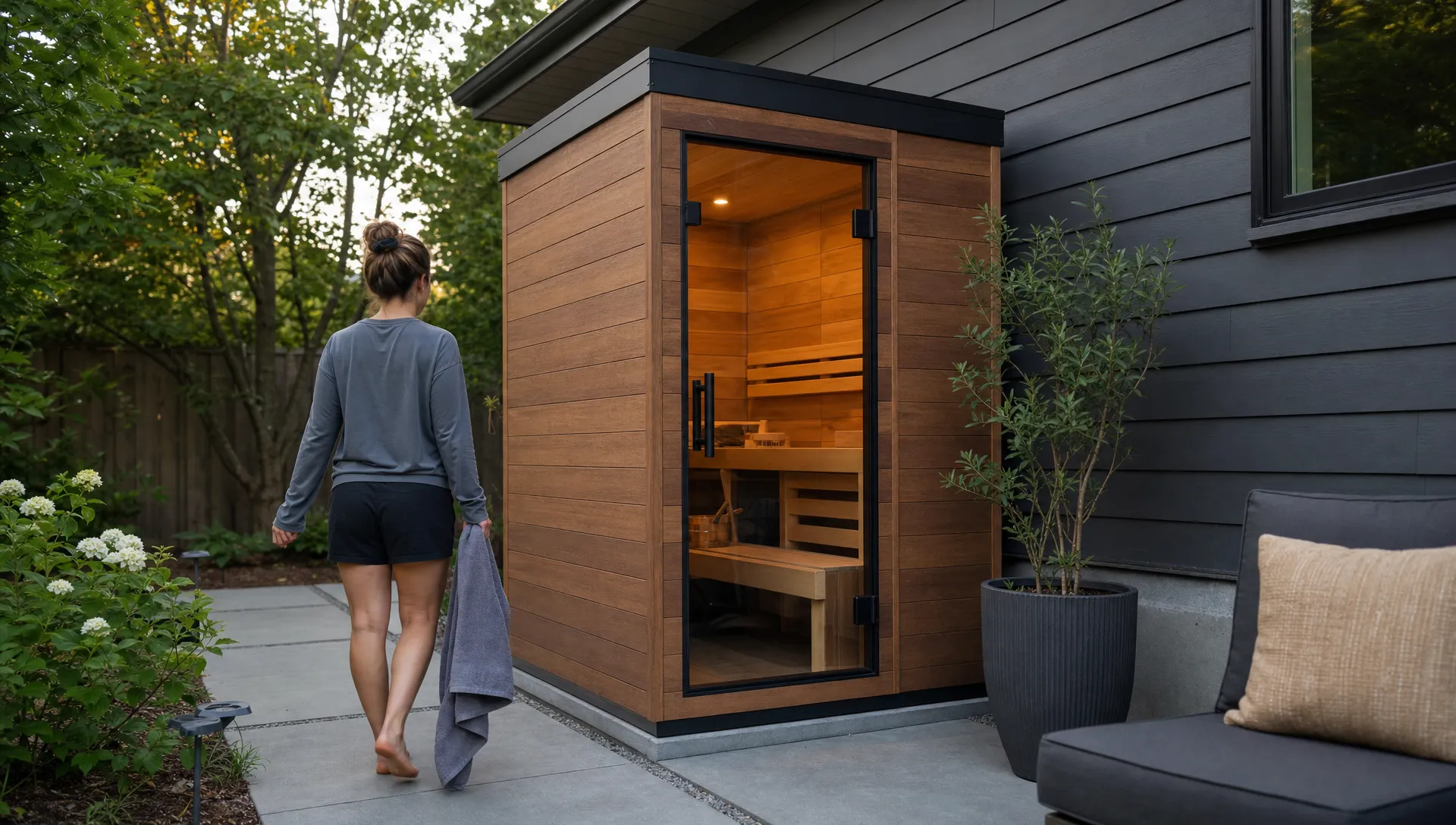 Wellness
Sauna Room Layouts That Make the Most of Limited Space
A small footprint can still leave room for comfortable seating and easy movement. Compare five layout approaches and learn what to check before buying a sauna for a tight space.
Read article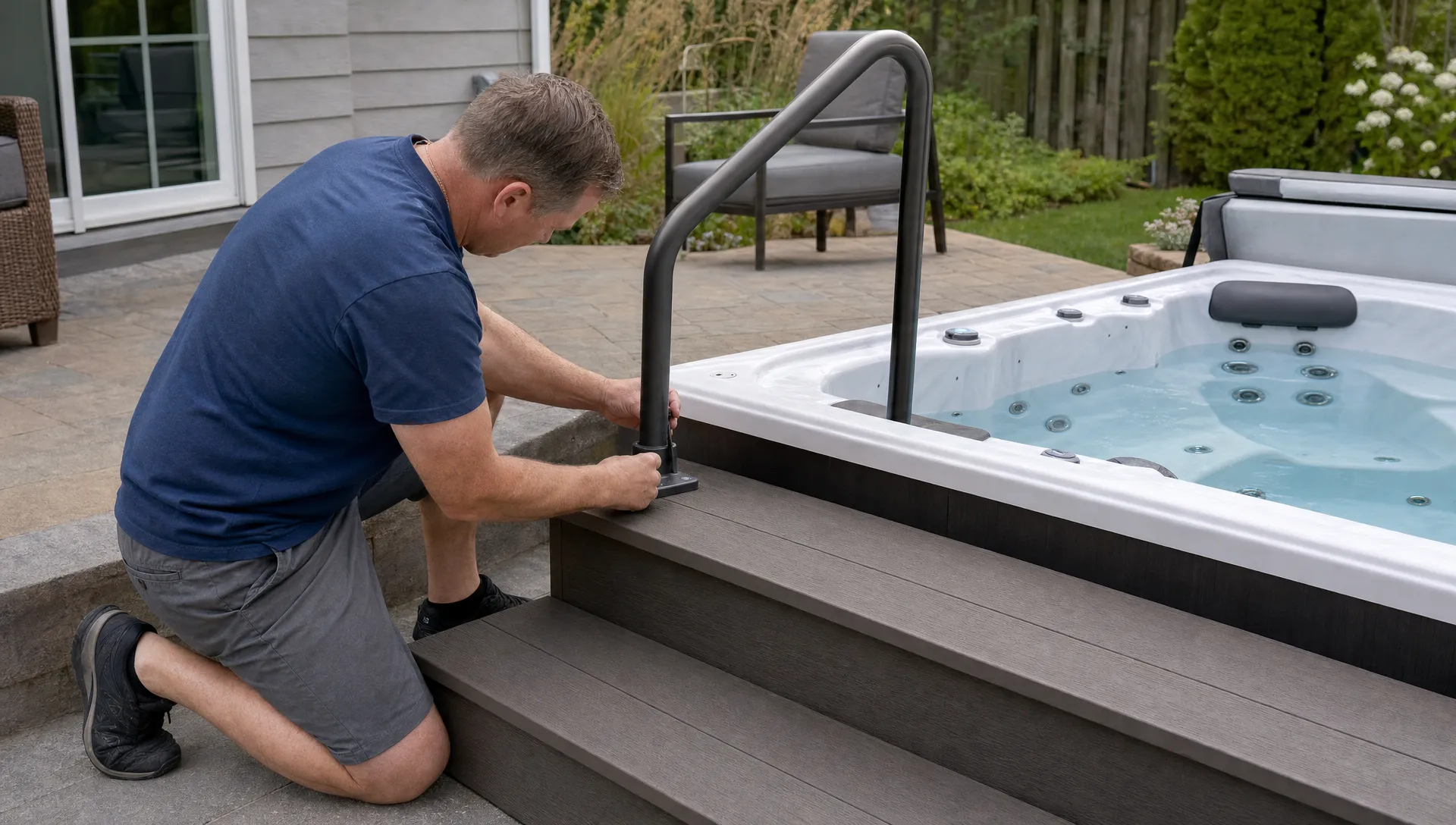 Wellness
Hot Tubs for Seniors With Easier Entry and Comfortable Seating
A comfortable spa starts with an entry route and seats that fit the person using it. Learn what to check before buying, from secure handrails and seat depth to cover handling and ongoing upkeep.
Read article Wellness
How to Read Hot Tub Reviews Without Falling for Hype
A glowing rating cannot tell you whether a spa fits your home or budget. Learn how to separate useful owner feedback from sales hype and verify the claims that matter before you buy.
Read article