
How to Read Hot Tub Reviews Without Falling for Hype

How to Read Hot Tub Reviews Without Falling for Hype — Wellness
A glowing rating cannot tell you whether a spa fits your home or budget. Learn how to separate useful owner feedback from sales hype and verify the claims that matter before you buy.
A five-star rating can tell you that someone liked a spa. It cannot tell you whether that spa will fit your body, suit your climate or be straightforward to service where you live. The most useful hot tub reviews connect an opinion to a specific model, ownership period and set of conditions.
Before you shortlist a purchase, separate three things: what the reviewer experienced, what the manufacturer documents and what you still need to verify. That distinction makes glowing recommendations and angry complaints much easier to judge.
Separate first impressions from ownership evidence
An unboxing review can show packaging, exterior finish and delivery condition. It cannot establish long-term reliability. A showroom visit may reveal seat dimensions and control placement, but it does not demonstrate how the spa feels when filled or performs through winter.
Look for a clear description of the reviewer’s access to the product. Did they use a dealer demonstration unit, buy the spa themselves or assemble an article from specification sheets? Each approach can provide useful information, but they answer different questions.
Ownership duration also matters. A first-week report is relevant to setup and initial comfort. An account written after several seasons can offer more context on maintenance, cover condition and repair experiences.
Treat the absence of hands-on testing as a limitation, not automatic evidence of dishonesty. A well-researched comparison can still help, provided it identifies its sources and does not present specifications as personal experience.
Match hot tub reviews to the source
Different sources have different strengths. Rather than searching for one perfectly unbiased recommendation, use each source for the questions it can reasonably answer.
| Review source | Most useful for | Main limitation |
|---|---|---|
| Individual owner account | Everyday comfort, routines and service experiences | One household may not represent typical ownership |
| Retailer product reviews | Feedback associated with a listed model | Listings may combine variants or older versions |
| Editorial comparison | Organizing features and explaining trade-offs | Hands-on testing may be limited or absent |
| Owner forum | Detailed troubleshooting and follow-up discussions | Problem-solving threads naturally attract owners with problems |
| Manufacturer testimonial | Examples of experiences the brand wants to highlight | Selected testimonials do not represent all customers |
Check the commercial relationship, too. Was the product supplied for free? Was the writer paid? Does the article earn commissions from purchases?
The FTC’s disclosure guidance explains that material connections between endorsers and brands should be disclosed clearly. A disclosure does not invalidate a recommendation, but it gives you context for evaluating it.
Look beyond the disclosure itself. A stronger comparison explains who each product does not suit, identifies missing information and describes how conclusions were reached. A page that praises every model without explaining trade-offs offers little help with an expensive decision.
Confirm that the review covers the model you can buy
Before using hot tub reviews to compare products, match the model name, configuration and approximate production period to the current listing. Similar names do not guarantee identical equipment.
A review may describe an optional package, a discontinued control system or a different seating layout. Retailer listings can also group feedback from multiple sizes or configurations, so inspect any variant labels attached to individual comments.
Record enough detail to establish a match: the model identifier, seating arrangement, electrical requirements and included equipment. Where a reviewer mentions an upgrade, check whether that upgrade is included in the price you are considering.
Recency needs context. An older account may document valuable long-term ownership, while a newer one may better reflect the current specification. Neither automatically outweighs the other.
If the product page, manual and review disagree, ask the seller for clarification in writing. Do not average conflicting specifications or assume the most favorable version applies to your order.
Turn enthusiastic claims into questions you can verify
Comfort and massage: look for fit, not adjectives
Words such as “powerful,” “luxurious” and “comfortable” describe reactions, not universal performance. Useful hot tub reviews explain the reviewer’s height, preferred seat, water depth and whether other people were using the jets simultaneously.
Someone who enjoys a deep seat may praise a layout that leaves a shorter user struggling to sit comfortably. A lounger that suits one person may allow another to float out of position.
Give more weight to descriptions of jet placement, adjustability and seat support than to a headline jet count. For a closer look at those differences, Hearthside Supply’s guide to choosing a hot tub beyond just the jet count explains what to compare.
Where available, a wet test can help you assess fit in a way photographs cannot. If that is not possible, request seat dimensions and ask how the layout accommodates your household’s heights. A dry sit can help with reach and space, but it does not reproduce buoyancy.
Energy costs: insist on operating context
A monthly electricity figure is not a reliable comparison unless you know the conditions behind it. When hot tub reviews promise inexpensive operation, look for the climate, water temperature, usage frequency, electricity rate and cover condition.
Also distinguish measured energy consumption from a rough estimate based on the household’s entire electricity bill. Heating, cooling and other appliances can change at the same time.
| Claim in a review | Evidence that makes it more useful |
|---|---|
| “Costs very little to run” | Measured consumption, local electricity rate and operating conditions |
| “Heats quickly” | Starting temperature, target temperature, weather and electrical configuration |
| “Seats the whole family” | Number and size of users, plus which seats they occupied |
| “Easy to maintain” | Actual testing, cleaning and water-care routine |
| “Excellent warranty” | Written coverage terms and details of a completed service claim |
Ask whether any published energy-test information applies to the exact model and configuration. Even documented test results need context before they become a realistic estimate for your backyard.
Maintenance and service: separate ease from lack of detail
“Maintenance-free” should prompt closer reading. A useful ownership account explains what the person actually does: tests the water, manages sanitizer, cleans filters and maintains the cover according to the product instructions.
Likewise, a review saying “great warranty” may mean the paperwork looked reassuring, not that the owner successfully used it. Look for a service timeline: the reported problem, diagnosis, parts availability, technician access and final resolution.
Check written warranty terms separately. Coverage periods, exclusions, labor arrangements and travel charges can affect the experience. A review from another region may not reflect service availability at your address.
At this stage, hot tub reviews should help you identify questions, not replace the documents that govern your purchase. Keep unresolved points visible rather than treating silence as confirmation.
Read negative feedback for patterns, not drama
One detailed complaint can reveal a question worth asking. It cannot establish a model-wide failure rate. You usually do not know how many units were sold, how owners were recruited to leave feedback or how many satisfied buyers stayed silent.
When reading negative hot tub reviews, separate the product issue from the surrounding circumstances. Shipping damage, installation problems, water-care difficulties and equipment failures require different follow-up questions.
Look for repeated, specific descriptions across independent accounts. Several owners identifying the same component and explaining similar symptoms deserve more attention than multiple vague claims that a spa is “junk.” Check whether those reports concern the same version and whether a resolution appears later in the thread.
Positive feedback deserves the same scrutiny. Repeated wording, generic praise and clusters of brief posts justify checking other sources, but they do not prove manipulation by themselves. A “verified purchase” label can support purchase authenticity without proving that the reviewer has extensive experience.
Use patterns to guide investigation, not to calculate failure rates from review counts. If a concern keeps appearing, ask the seller whether it applies to the current configuration and what support would be available if it happened to you.
Build an evidence worksheet instead of chasing a star average
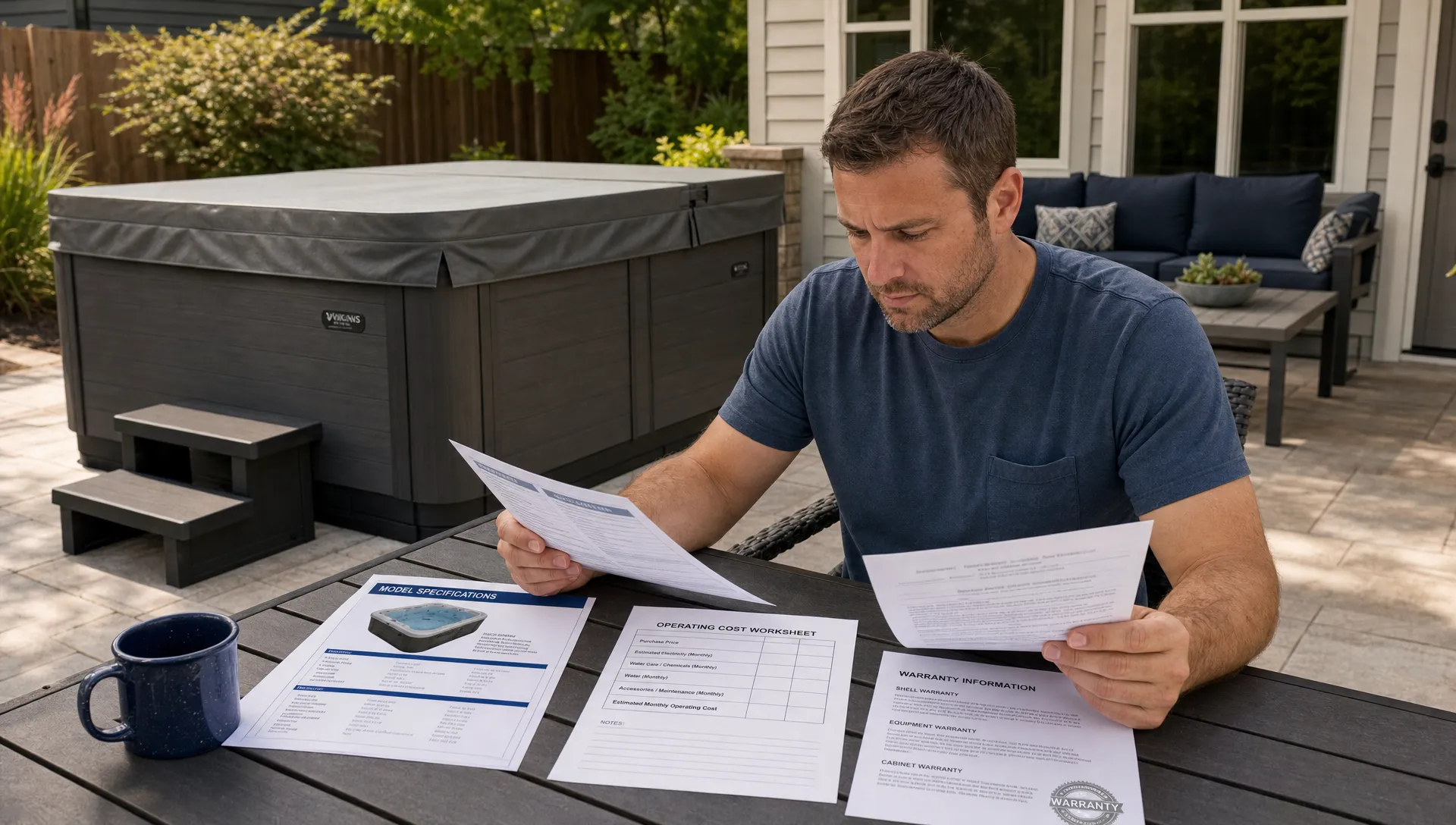
A short worksheet makes hot tub reviews easier to use because it separates appealing features from confirmed facts. Create one column for each shortlisted model and record evidence under the same headings.
Keep the worksheet focused on your household rather than assigning arbitrary scores to every accessory.
- Fit: Relevant owner heights, usable seats, access to controls and any wet-test observations.
- Operation: Electrical requirements, documented energy information and the conditions behind owner cost reports.
- Care: Maintenance tasks described by owners and requirements in the manual.
- Support: Written warranty terms, local service arrangements and detailed repair experiences.
- Unknowns: Conflicting specifications, missing documents and questions awaiting a written answer.
Label each finding as documented, reported by an owner or unverified. Those labels prevent a persuasive anecdote from quietly turning into an assumed specification.
For example, “the owner found the lounger comfortable” belongs under reported experience. “The current model includes this electrical configuration” needs support from the relevant product documentation. “Annual operating cost will be low” remains unverified without a defensible estimate.
A model with fewer reviews may still deserve consideration if its documentation and support arrangements answer your priorities. More reviews provide more material to examine, not an automatic guarantee of better quality.
Turn your shortlist into written questions before checkout
Once hot tub reviews have narrowed the field, use the remaining gaps to guide a conversation with the seller. Ask specific questions that can produce specific answers.
Instead of asking whether a spa is economical, ask what energy information is available for that configuration. Rather than asking whether support is good, ask who handles diagnosis and repairs in your area and which charges may fall outside coverage.
Confirm that the quoted product includes the equipment discussed in the reviews. Keep delivery responsibilities, installation requirements and return conditions separate from judgments about the spa itself. A comfortable product and a suitable purchase arrangement are two different checks.
Hearthside Supply’s guide to evaluating an online hot tub store can help you assess that seller-side information without relying on star ratings alone.
Save the applicable specification sheet, warranty and written answers before ordering. If an essential requirement remains unclear, pause the purchase until it is resolved.
Frequently asked questions
Are five-star hot tub reviews trustworthy? They can be, but the rating alone provides little evidence. Look for a matching model, meaningful ownership duration and specific observations. A balanced account that explains limitations is generally more useful than enthusiastic praise without context.
Should I ignore reviews that use affiliate links? No. Affiliate links indicate a commercial incentive, not automatic inaccuracy. Check for a clear disclosure, an explanation of the evaluation method and meaningful drawbacks. Verify important specifications independently.
Can owner feedback predict how long a spa will last? Long-term accounts can reveal wear and repair experiences, but they cannot guarantee lifespan. Maintenance, environment, usage and model revisions can differ. Look for documented service history and repeated patterns rather than treating one unusually good or bad experience as typical.
What is a good hot tub to buy? A good choice fits your household, installation site, maintenance expectations and budget. Use reviews to evaluate lived experience, then verify current specifications, purchase terms and service arrangements. The highest-rated option is not necessarily the best match for your home.
Compare products with the evidence in hand
Use reviews to discover strengths, trade-offs and questions you might otherwise miss. Make the final decision using current documentation and answers relevant to your address and household.
When you are ready to compare options, explore Hearthside Supply’s home wellness selection with your evidence worksheet beside you. Focus on the models that meet your requirements, not the ones with the loudest praise.
Ready to invest in your home wellness?
Explore our curated selection of premium saunas, hot tubs, cold plunges, steam showers, and swim spas — with clear specifications, nationwide delivery, and secure checkout.
Keep reading
View all posts Wellness
Sauna Room Layouts That Make the Most of Limited Space
A small footprint can still leave room for comfortable seating and easy movement. Compare five layout approaches and learn what to check before buying a sauna for a tight space.
Read article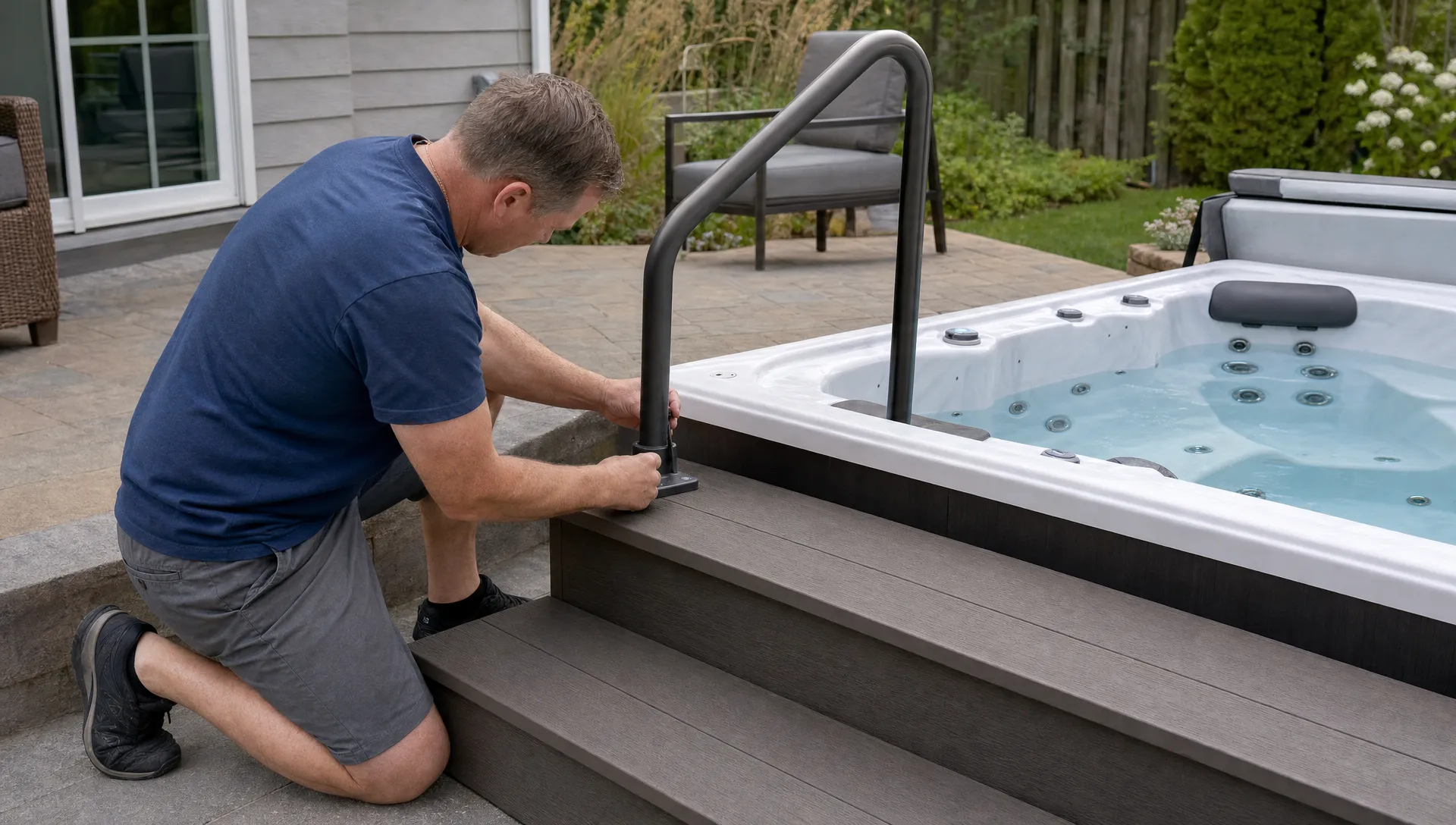 Wellness
Hot Tubs for Seniors With Easier Entry and Comfortable Seating
A comfortable spa starts with an entry route and seats that fit the person using it. Learn what to check before buying, from secure handrails and seat depth to cover handling and ongoing upkeep.
Read article Wellness
Is a Dual-Zone Hot Tub Swim Spa Combo Worth the Extra Cost?
Separate temperatures can make swimming and soaking easier, but they also add cost and maintenance. Compare the upgrade with a single-zone spa or separate units before deciding which setup fits your household.
Read article